The brief
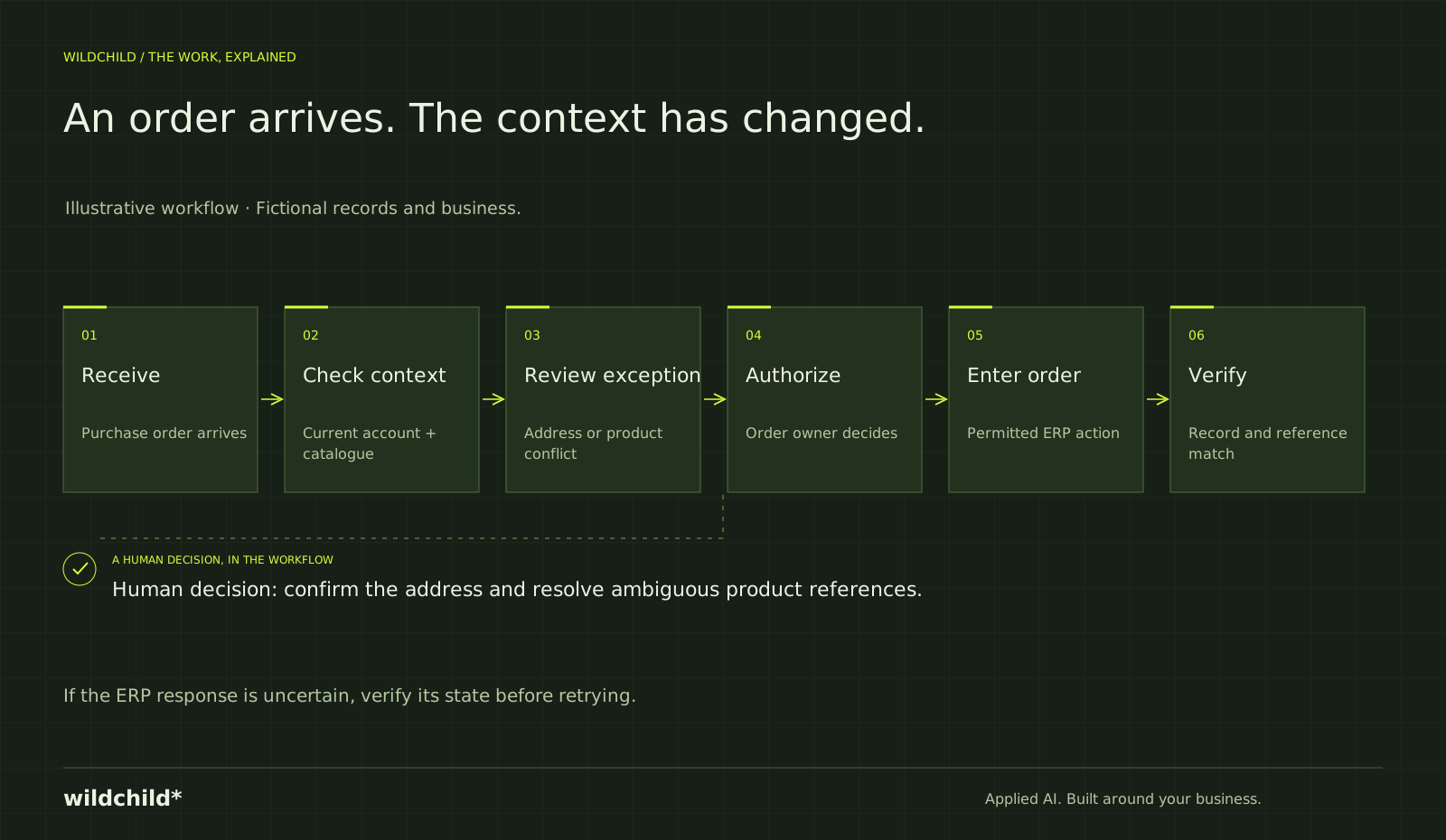
Harborline Supply's order desk receives purchase orders by email. Staff read attachments, identify customers and products, check records, resolve exceptions and enter orders into an ERP.
The fictional sponsor wants more capacity at the order desk while preserving order quality. The first decision is which recurring workflow deserves investigation and what a deployment would need to prove.
Artifact 1 · The current workflow
| Stage | What happens | Where work can wait | Evidence to collect |
|---|---|---|---|
| Receive | An email and purchase-order attachment reach the desk. | Duplicate messages or incomplete requests. | Received timestamp, source document and case identity. |
| Identify | Staff locate the account and interpret product references. | Ambiguous references or missing account details. | Candidate records and the reason a match was chosen. |
| Check | Staff compare address, quantities, terms and relevant rules. | Conflicting records or an exception needing approval. | Source versions, authority and applicable policy. |
| Decide | The order owner resolves exceptions. | Waiting for internal or customer clarification. | Decision, owner and supporting evidence. |
| Enter | The authorized order is entered into the ERP. | Unavailable interface or uncertain action result. | Submitted fields, action identifier and response. |
| Confirm | Staff verify the record and complete the case. | Mismatch or missing confirmation. | Confirmed ERP reference and accepted outcome. |
Artifact 2 · The opportunity shortlist
| Candidate | Illustrative monthly volume | Why investigate | Dependency | Recommendation |
|---|---|---|---|---|
| Order intake | 1,000 | Known owner, recurring handling and a visible completion state. | ERP access and product-reference rules. | Investigate a bounded category first. |
| Order-status enquiries | 400 | A defined request with repeated information gathering. | Delivery status comes from several sources with different freshness. | Map source authority and coverage before scoping. |
| Invoice discrepancies | 90 | Repeated investigation with supporting records. | Financial decision rights and sample-case access are unresolved. | Confirm ownership and authority before comparing economics. |
The order-intake recommendation is conditional. Volume alone did not determine it. The next step is to verify access, baseline effort and the review requirements for a limited scope.
Artifact 3 · Baseline and unknowns
| Field | Illustrative assumption | What needs validation |
|---|---|---|
| Total order workload | 1,000 cases per month | Count and deduplicate actual cases for a defined period. |
| Human handling | 12 minutes per case | Observe representative cases; include review and rework. |
| Implied total monthly case effort | 200 hours | 1,000 × 12 ÷ 60; depends on the assumptions above. |
| Loaded labor rate | US$45 per hour | Agree the relevant costing basis with finance. |
| Exception share | Unknown | Categorize exceptions in the sample. |
| Elapsed time | Unknown | Measure received-to-accepted time separately from effort. |
| Current quality and rework | Unknown | Define acceptance, correction and reopening rules. |
| Implementation and recurring cost | Not quoted | Establish after technical and operating scope is understood. |
No ROI claim follows from this table. It frames the information needed to decide whether the opportunity is worthwhile.
Artifact 4 · Proposed deployment blueprint
Unit of work: A purchase order in one supported product category, received through the agreed inbox.
Accepted outcome: An authorized order in the ERP with required fields verified and a confirmed reference retained in the case.
Initial boundaries: One inbox, one order category, one target ERP and approved account, catalogue and policy sources. Credit decisions, pricing overrides, payments and unsupported order formats remain outside automated action scope.
Sources: Purchase order, customer master, product catalogue, relevant order policy and ERP state. Source owners must confirm access, authority and refresh behavior.
Product responsibilities: Alloy supplies permitted context and history. Relay coordinates the case and authorized actions. Foundry provides the review workspace. Bridge supports evaluation, operating review and release decisions.
Human decisions: An authorized order owner resolves conflicting delivery instructions, uncertain product matches and commercial exceptions. The workflow retains the reason and evidence.
Failure behavior: Missing evidence routes to review. Uncertain ERP outcomes require state verification before a potentially duplicating retry. Unavailable dependencies leave the case in a visible waiting state.
Evaluation design: A proposed set of 60 fictional test cases: 30 ordinary orders, 10 ambiguous product references, 5 address conflicts, 5 missing-information cases, 5 duplicates and 5 system-failure cases. This set is a design example and has not been executed. Separate permission tests cover restricted sources and unauthorized actions.
Release conditions: Required fields and external confirmation must be correct for an automatically completed case. Every defined exception must reach its expected owner and state. Critical permission or duplicate-action failures block release. The process owner and control owners agree the broader quality, cost and review-effort criteria before a pilot.
Operating owner: The customer order-operations lead, supported by named technical and control owners. Wildchild's responsibilities depend on the delivery scope.
Handover: Demonstrate monitoring, exception review, source maintenance, supported change and recovery tasks. Record software support and any optional Managed Operations separately.
A changing record inside the workflow
The example order lists 18 Dock Street. The approved customer master now lists 42 Quay Road, effective before the order date. The example policy requires review of the mismatch.
At the same time, MX-20 could refer to a single unit or a case. The reviewer sees both issues, confirms the address under policy and resolves the product choice before the permitted order-entry step.
The decision brief
Recommendation: Proceed to a scoped investigation of the order-intake category.
Resolve first: Validate the baseline, confirm the supported ERP interface, identify product-match rules and agree the review owner.
Do not conclude yet: Deployment timing, achievable automation rate, realized savings or readiness for wider order categories.
Next investment decision: Whether the verified scope and expected complete cost justify building and evaluating a limited workflow.
What a real engagement would add
Customer evidence, source authorization, tested technical options, actual commercial scope and decisions by the people responsible for the business. The value of the diagnostic is a clearer decision with its assumptions visible.