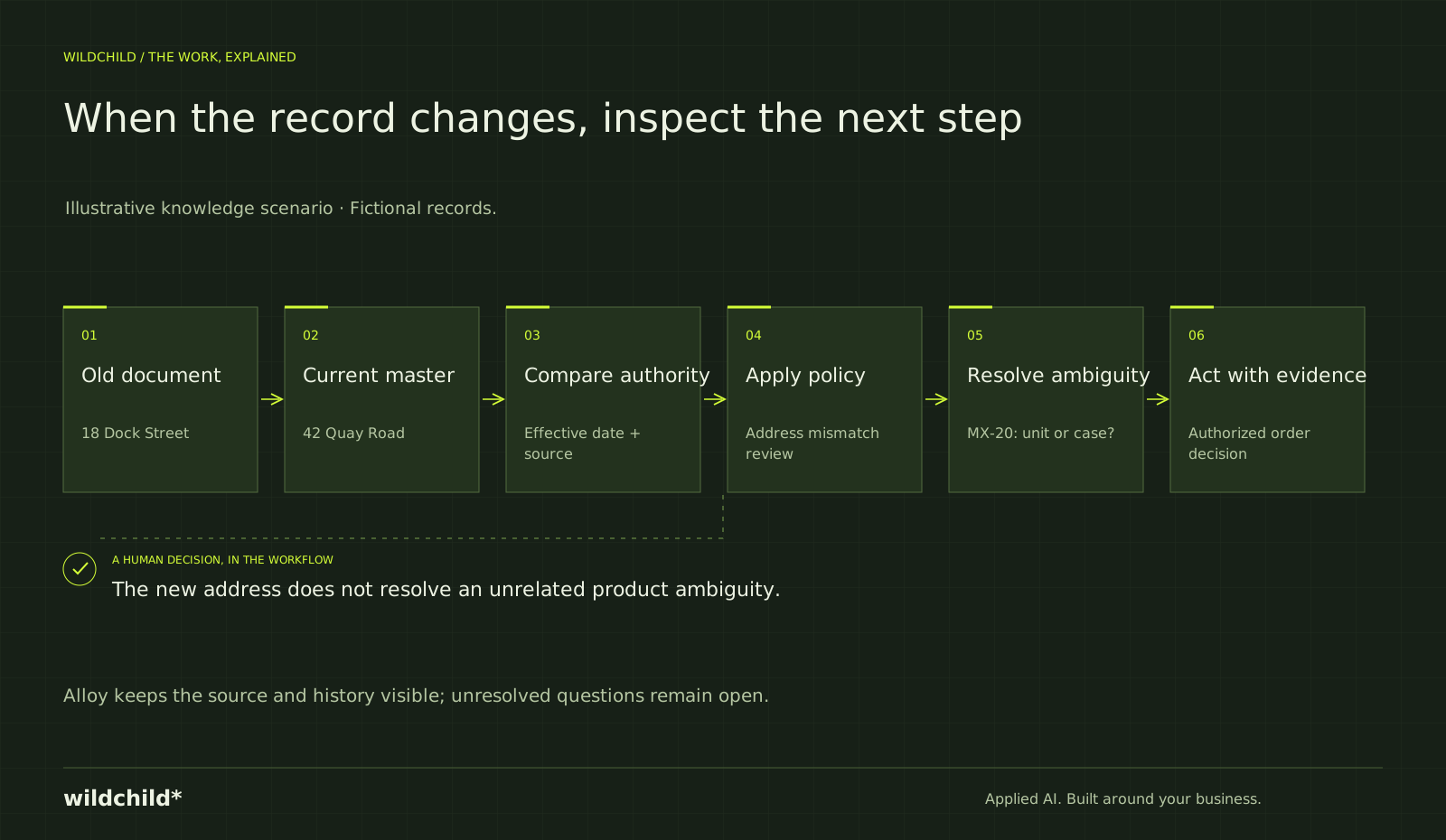
Which address belongs on the order? The answer depends on the authority of the records, when the change takes effect and the policy for handling a disagreement. Finding both addresses is only the beginning of the task.
The following fictional example shows the behavior we are designing around in Wildchild AI OS. It is an illustration, not a demonstration of a released customer deployment.
Make the changed fact inspectable
The incoming order lists 18 Dock Street. The approved customer master lists 42 Quay Road, effective from 1 September. The order arrives after that date.
A useful context view shows the current address, the prior value, the source of each and the change's effective date. It also shows whether the person or agent accessing that information is permitted to do so.
The old address remains part of the history. The workflow needs a rule for deciding what authority that history carries now.
Apply the policy for the actual decision
In this example, an address mismatch requires the order owner to confirm the shipment destination. The newer master record is evidence for that decision. It does not silently override the review policy.
The reviewer should see the difference and the reason review is required. Once the authorized person decides, the workflow records the selected address and the relevant evidence.
Another business might authorize a different rule for this case. The design needs to make that rule explicit and test it.
Keep unrelated uncertainty unresolved
The same purchase order includes “MX-20.” The catalogue has a single-unit item and a case item that can both match that reference.
The approved address change does not resolve the product ambiguity. The workflow should retain the two candidates, ask the appropriate person to clarify and avoid treating a plausible match as a confirmed fact.
This is why useful company knowledge includes unresolved questions. A clean-looking record that hides uncertainty can give the next step more confidence than the evidence supports.
Connect context to action and confirmation
In the intended Wildchild model, Alloy supplies the relevant records and history. Relay follows the workflow and pauses affected actions. Foundry gives the operator the evidence and permitted choices. Bridge supports the operating record and review.
After the decisions are made, the workflow can attempt the authorized order entry. It still needs to confirm the resulting ERP record. Knowing which action should happen and knowing that it happened are separate pieces of evidence.
Test change as part of the workflow
An evaluation should include an old document with a current master record, a future-dated change, two sources with conflicting authority, an unavailable source and a user who lacks access. Each case tests a different assumption about what “current knowledge” means.
For each case, define the expected decision: proceed under a specific rule, ask for review, obtain missing information or deny access. Inspect the evidence and the resulting action together.
A useful question for your own team
Choose one fact that changes in your business: a price, delivery address, approval limit or service entitlement. Ask where it is maintained, who authorizes it, when it applies and which workflow decisions depend on it.
That discussion reveals what a maintained company memory actually needs to do.
Explore Alloy
Read the evaluation method
Discuss a workflow that depends on changing information