AI keeps advancing. Your business still needs a way forward.
New models, agents and tools create new possibilities. For a business leader, they also create a continuing set of decisions: what matters, what is ready, where to invest and what the team can realistically adopt.
A promising demonstration is the beginning of that work. The capability still needs current company knowledge, access to the right systems, a useful place in the workflow, clear decision rights and people who know how to operate it.
Adoption can stall when those pieces are missing. Teams return to familiar workarounds. Pilots remain separate from everyday operations. Time moves into checking and fixing outputs. Another tool arrives before the value of the last one is clear.
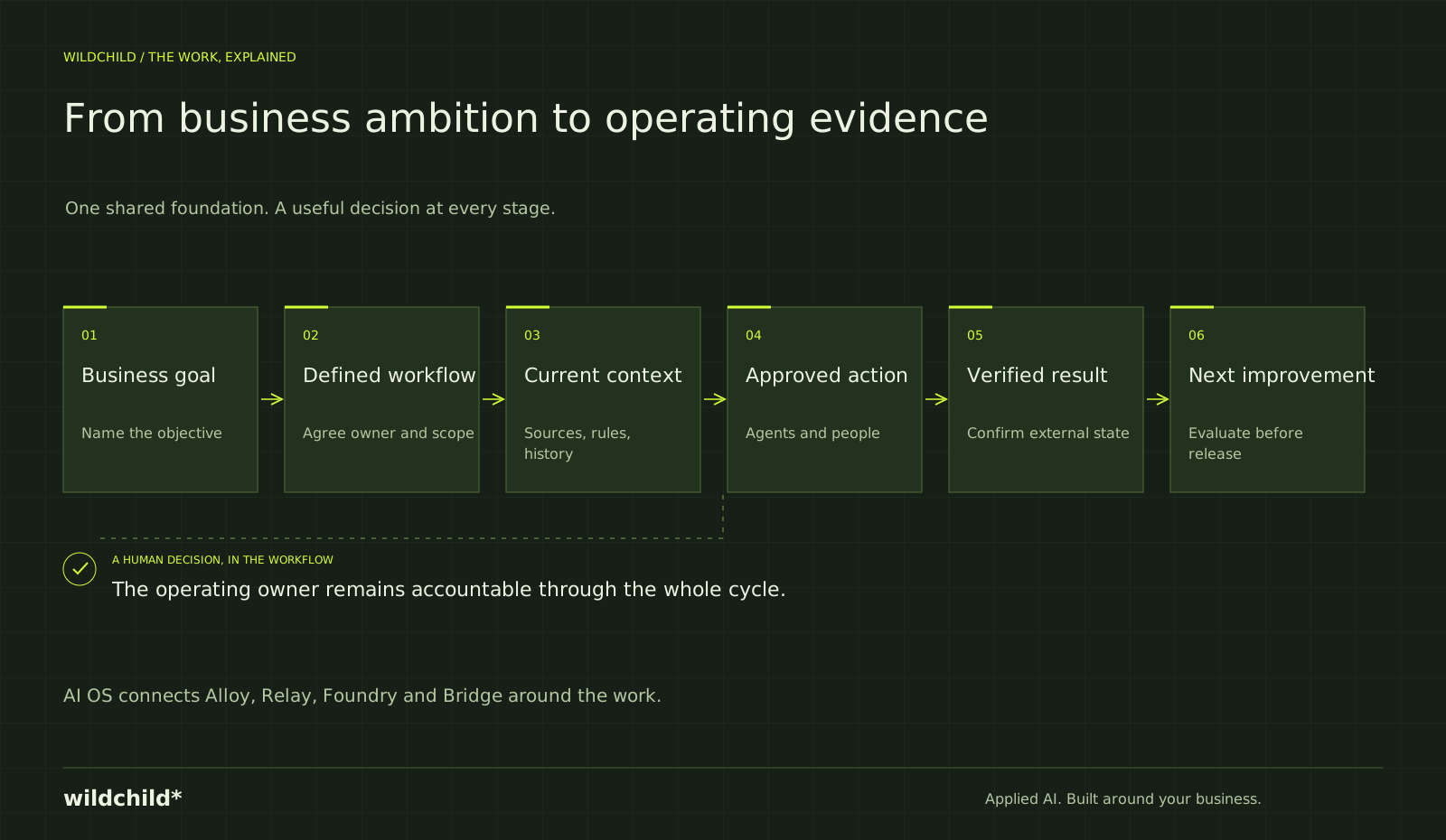
Wildchild exists to help close the distance between what AI can do and what your business can use. We help choose the work worth changing, build the connected capability around it, prepare the people who will run it and use operating evidence to decide what improves next.
Keep moving with AI. Build on what works for your business.
1. Understand the work
Walk through representative cases with the people who handle them. Identify the trigger, information, decisions, handoffs and exceptions. Connect the workflow to the business objective and name its owner.
You should be able to inspect: a workflow map and a record of the evidence behind it.
The decision: Is the problem sufficiently understood to assess a useful change?
2. Establish the case for change
Measure the relevant volume, handling effort, quality, delay and cost. Compare candidate workflows and expose the assumptions behind expected value. Resolve access and ownership questions early.
You should be able to inspect: an opportunity shortlist, baseline and proposed scope.
The decision: Is there a credible reason to proceed, and what must be learned first?
3. Design and evaluate
Define the required sources, actions, applications and controls. Build the supported workflow and test normal cases, exceptions, permissions and recovery against explicit acceptance conditions.
You should be able to inspect: a deployment blueprint, case set, results and open issues.
The decision: Does the evidence support a limited release?
4. Introduce it with the team
Let operators practice real tasks and difficult cases. Establish the review queue, escalation route and operating cadence. Limit the initial rollout to the agreed scope and observe how the work changes.
You should be able to inspect: operating instructions, training exercises and release conditions.
The decision: Can the team use the workflow reliably within its boundaries?
5. Hand over and improve
Demonstrate the customer's operating responsibilities. Record remaining dependencies and support arrangements. Use the first operating reviews to decide whether to refine, expand or pause.
You should be able to inspect: the handover record, value review and prioritized improvement work.
The decision: Can the agreed team operate this release, and what should happen next?
Who needs to be involved?
| Role | The responsibility to agree |
|---|---|
| Business sponsor | The objective, investment decision and acceptable business trade-offs. |
| Process owner | The workflow, acceptance definition and exception decisions. |
| Operators and reviewers | Everyday use, realistic cases and feedback on the experience. |
| IT and control owners | Systems, access, processing arrangements, release and recovery requirements. |
| Finance reviewer | The baseline, total cost and evidence of realized value. |
| Wildchild delivery team | The scoped discovery, configuration, evaluation support and handover work. |
What independent operation should demonstrate
Your team can monitor the workflow, resolve its usual exceptions, maintain its agreed sources, manage access, recover from defined failures and evaluate a supported change. The evidence comes from performing those tasks.
Managed Operations can cover responsibilities your team wants help with. It is an option to scope, separate from the decision to deploy.
Questions
Is this a fixed timeline?
No. These are decision stages. Timing depends on access, available capabilities, integration work and acceptance conditions.
Can we stop between stages?
The engagement should define decision points and commitments. A decision to narrow the scope, use a simpler approach or wait can be a useful outcome.
How does the second workflow become easier?
It may reuse context, interfaces, operating practices and application patterns. Assess that reuse against the second workflow's actual requirements; demonstrate the benefit through delivery evidence.