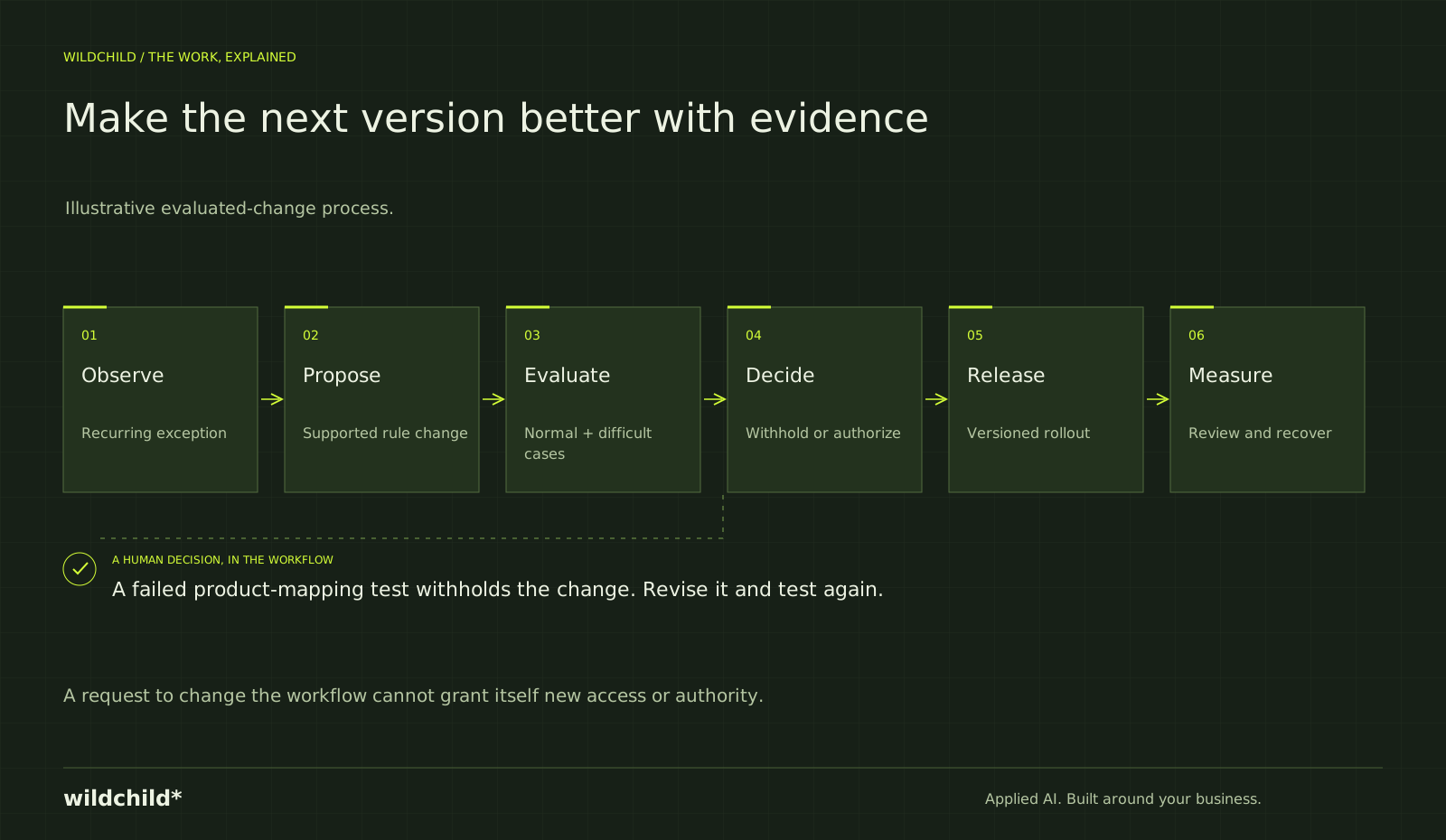
This is Wildchild's proposed evaluation method. It describes what to examine; it does not publish a benchmark result or claim that a particular implementation has passed.
Start with the accepted outcome
Describe the state a successful case must reach. For order intake, the result might require the correct authorized order in the ERP, a verified reference and a complete decision record.
Then define unacceptable outcomes. Examples include acting without the required approval, exposing restricted information, duplicating a transaction or silently closing unresolved work. These failures need explicit release rules.
Build a case set that represents the work
Include ordinary requests, known exceptions and less frequent cases with important consequences. Record where each example came from and which part of the scope it represents.
Use separate cases when developing the workflow and assessing a candidate release. If a team adjusts the system to pass every example in the release set, it needs fresh evidence to judge generalization.
Synthetic cases can help exercise specific boundaries. Customer-sourced examples, used under the agreed data arrangements, are still needed to understand real operating conditions.
Evaluate the decisions and actions
For each case, inspect the evidence used, the expected decision, the action attempted and the confirmed outcome. Check that waiting states and human decisions remain understandable.
Permission tests should include an unauthorized user, a restricted source and an action outside the workflow's authority. A correct-looking response does not excuse an unauthorized path to producing it.
Exercise failure and recovery
Interrupt a dependency. Remove a required field. Return an ambiguous system response. Confirm what the workflow does when it cannot tell whether an action succeeded.
For a transactional action, the recovery path should establish the external state before repeating an operation that could create a duplicate. Review how the case is paused, who is notified and what evidence the operator receives.
Count the remaining work
Measure review effort, correction effort, latency and cost alongside accepted outcomes. A change that improves one score while making the workflow impractical to operate needs a wider assessment.
Report the scope, case count, period, model and configuration, result definitions and important limitations with any published figures. Keep measured results separate from projections.
Make the release decision explicit
The release owner needs the results, unresolved issues and the consequences of those issues. Agree whether to release within a limited boundary, revise and retest, or withhold the change.
Our fictional product-mapping example includes a proposal that fails an ambiguity case and is withheld. The process has done useful work by exposing that failure before it reaches routine operation.
Continue after release
Monitor the work under actual conditions. Compare observed cases with the evaluation set, inspect new exceptions and revise the tests when the business changes.
Evaluation becomes an operating practice: a documented reason for the current release and a method for deciding whether the next version is better.
Explore Bridge
See the deployment approach
Discuss your evaluation requirements