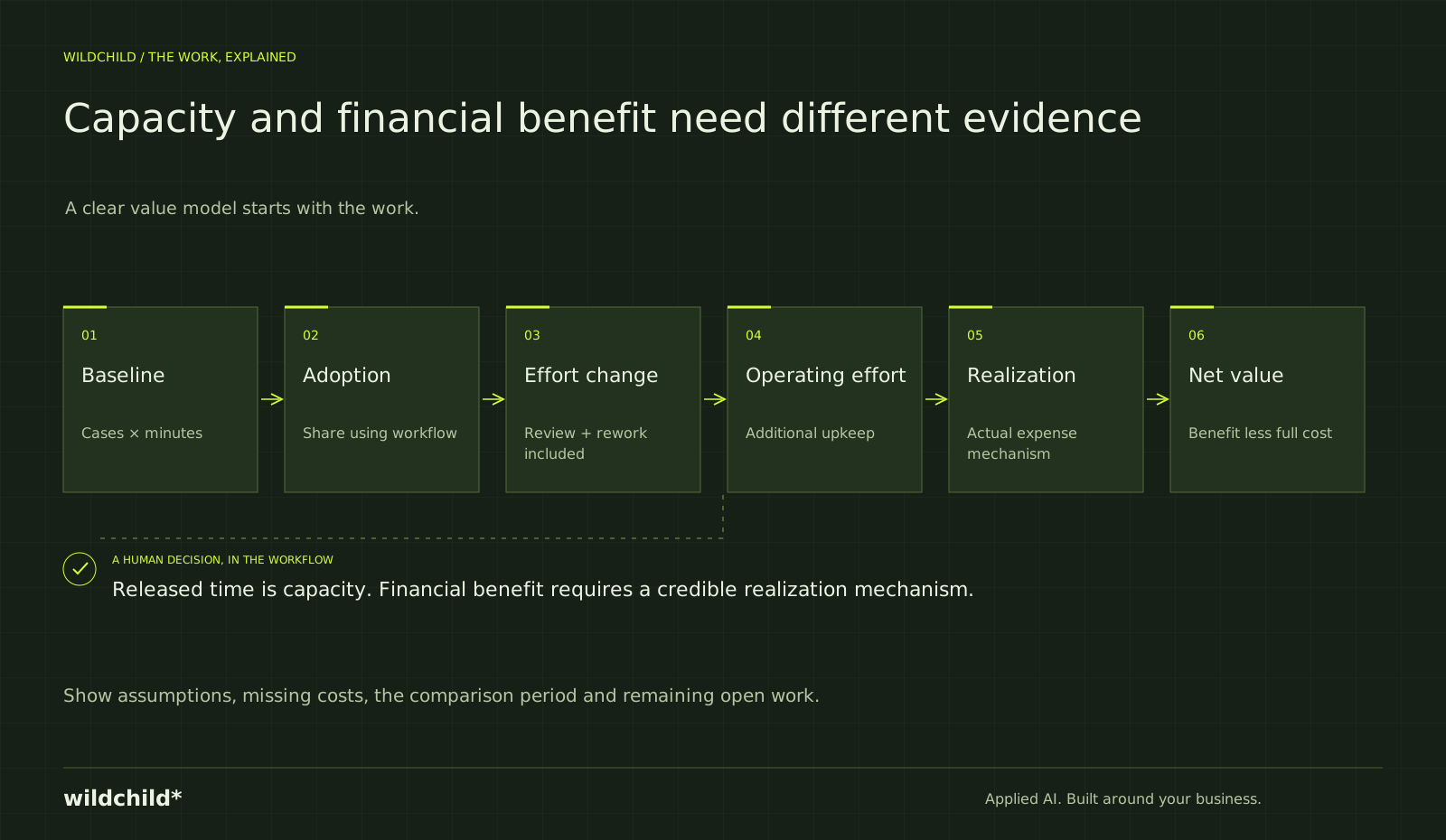
A useful value review makes these differences visible. Start with the accepted business outcome, then follow the work and cost required to produce it.
Keep the denominators visible
Record how many cases were eligible, how many used the workflow, how many reached the accepted outcome and how many remained open. Use a defined period and a consistent case boundary.
The adoption rate answers how much eligible work used the workflow. The acceptance rate answers how many attempted cases reached the required result. Both help interpret performance; neither is a general measure of AI accuracy.
Compare the complete human effort
The baseline should reflect comparable work and a stated measurement method. After release, include handling, review, corrections and work on unsuccessful cases.
Add recurring operating effort such as checking queues, maintaining sources and reviewing performance. Otherwise, time can appear to disappear from one role while simply moving to another.
Worked monthly example
All numbers below are fictional assumptions for one illustrative month. They are not a forecast, benchmark or Wildchild customer result.
| Measure | Example | Interpretation |
|---|---|---|
| Eligible orders | 1,000 | The defined monthly workload. |
| Attempted through the workflow | 800 | 80% of eligible orders. |
| Accepted by the review cutoff | 760 | 95% of attempts; 40 remain unresolved. |
| Baseline effort for 800 comparable cases | 160 hours | 800 × 12 minutes ÷ 60. |
| Current case effort across all 800 attempts | 66 hours 40 minutes | 800 × 5 minutes ÷ 60; includes review, rework and work already spent on unresolved cases. |
| Additional recurring operating effort | 20 hours | Excludes the case effort already counted. |
| Provisional released capacity | 73 hours 20 minutes | 160 − 66⅔ − 20. |
The unresolved cases need follow-up. Additional work on them must enter the next reconciliation, which can reduce the apparent capacity benefit. The 200 unattempted cases sit outside this comparison.
Capacity has a use. Financial benefit has a mechanism.
At an illustrative loaded labor rate of US$45 an hour, 73⅓ hours has a capacity equivalent of US$3,300. That amount is not cash saved.
To establish financial benefit, record what actually changed: an expense avoided, an external cost reduced or additional contribution supported by attributable output. If released time is redeployed, name the work and inspect whether it happened.
For this fictional review, realized cash savings remain unverified. That is a valid result when the evidence has not established a financial change.
Include the cost of the capability
In the example, case labor costs US$3,000 and recurring operating labor costs US$900. Add US$900 of technology and usage cost: US$4,800 in period operating cost, or about US$6.32 per accepted case.
An illustrative US$600 allocation of deployment cost brings the fuller figure to US$5,400, or about US$7.11 per accepted case. Show the allocation method alongside the total. Do not compare these figures with a baseline cost per case that uses different completion rules or omitted costs.
End with a decision
The review should identify the next owner and action. In this example: resolve the 40 open cases, investigate the main review cause and measure the true effort before expanding scope.
An operating review is useful when it helps the team decide whether to continue, correct, expand or stop.
Explore Bridge
See the workflow behind the sample
Discuss your measurement approach